CHANGE LANGUAGE | Home > Technical Analysis Advanced > On fractal distribution function estimation and applications > Theorem 4 (Iacus and La Torre, 2001)

On fractal distribution function estimation and applications

Introduction

Theoretical background for affine IFS

2.1 Minimization approach

Theorem 1

Theorem 2 (Collage theorem)

Theorem 3 (Forte and Vrscay, 1995)

2.2 Direct approach

Theorem 4 (Iacus and La Torre, 2001).

Theorem 5 (Iacus and La Torre, 2001)

Corollary 6

Theorem 7

2.3 The choice of affine maps

3 Fourier analysis results

Theorem 8 (Forte and Vrscay, 1998)

Theorem 9 (Collage Theorem for FT, (Forte and Vrscay, 1998))

4 Statistical applications

4.1 Asymptotic results for the quantile-based IFS estimator

Theorem 10

Theorem 11

Theorem 12 (Gill and Levit, 1995)

Theorem 13

4.2 Characteristic function and Fourier density estimation

5 Monte Carlo analysis

5.1 Applications to survival analysis

Final remarks

References

On fractal distribution function estimation and applications

Theorem 4 (Iacus and La Torre, 2001)

Under conditions i) to v):

1. Tp is an operator from

to itself.
2. Suppose that wi(x) = x, P i = p, and δi ≥ −p, then

3.
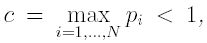

then Tp is a contraction on
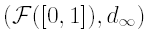
with contractivity
constant c.

4. Let
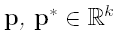
such that TpF1 = F1 and Tp* F2 = F2. Then
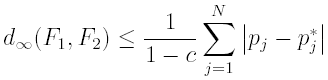
where c is the contractivity constant of Tp. The theorem above assures the IFS nature of the operator Tp that can be denoted, as in the previous section, as a N-maps IFS(w, p) with obvious notation. The goal is again the solution of the inverse problem in terms of p. Consider the following convex set:

open full size image

then we have the following results:

... in Theorem 5

Stefano M. Iacus, Davide La Torre

PerformanceTrading.it ed il suo contenuto sono di esclusiva proprietà degli autori. E' vietata la riproduzione anche parziale di qualsiasi parte del sito senza autorizzazione, compresa la grafica e il layout. Prima della consultazione del sito leggere il disclaimer nella sezione [info].