Home >
Doc >
On fractal distribution function estimation and applications >
2.3 The choice of affine maps
As we are mostly concerned with estimation, we briefly discuss the problem of choosing the maps. In Forte and Vrscay (1995) the following two sets of wavelet-type maps are proposed. Fixed and index

define


and


Then set

respectively. To choose the maps, consider the natural ordering of the maps ωij and operate as follows


and


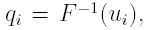
respectively. Our quantile based maps are of the following type

where
and

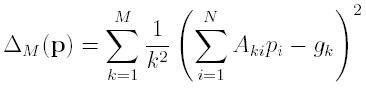
are N + 1 equally spaced points on [0, 1]. For each given sets of maps w (W1, W1 and Wq) di erent p's will be solution of (Q) (or (P)). Whether the corresponding fixed point is closer to a given F in the three cases is not always clear. As an example, in Table 1 we show the relative performance of the approximation based on the quantity
(that is an approximation of the collage distance), on the sup-norm d1 and on the average mean square error, AMSE. We also report the contractivity constant in both the space M([0, 1]) and the space F([0, 1]). Recall that the collage theorem for the moments establishes that, if g is the vector of moments of a the target measure µ (of a distribution function F) and is the moment vector of the invariant measure ¯µN of the IFS (w, p) then
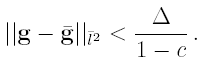
Table 1 shows that, at least in this classical example of the IFS literature, for a fixed number of maps N, TN is a better approximator than M relatively to the sup-norm and the AMSE while the contrary is true in terms of the approximate collage distance ΔM(p). As noted in Forte and Vrscay (1995), M uses not all the maps, in the sense that N0, the number of non null probabilities, is usually smaller than N'. It is evident that, two alternatives seem promising in the perspective of distribution function estimation: M with W1 and TN (i.e. M with maps Wq and pi = 1/N). Note that it is apparently simpler to use TN because there is no need to calculate moments.
Stefano M. Iacus, Davide La Torre
Next: 3 Fourier analysis results
Summary: Index