CHANGE LANGUAGE | Home > Doc > Learn Relative Strength Point & Figure Charting > Theory of Runs

Market Dynamics Learn Relative Strength Point & Figure Charting

The Spirit of Technical Analysis

Chart construction and layout

Region of Excess Return

Region of serious under-performance

Extreme volatility - Shortest time period

Analysis of trends

Triple top buy signal

Triple bottom sell signal

45 degree lines- Bullish

High performance bullish support lines Example 1-2

High performance bullish support lines Example 3-4

High performance bullish support lines Example 5-6

High performance bullish support lines Example 7-8

High performance bullish support lines Example 9-10

Support and resistance

Resistance below the bearish resistance line

Trading ranges

Channels

Major long-term trends Example 1-2

Major long-term trends Example 3-4

Major long-term trends Example 5

Major long-term uptrends Example 1-2

Major long-term uptrends Example 3-4

Major long-term uptrends Example 5

Major long-term down-trends

Natural trendlines

Major reversal patterns

Major bases

Breakouts Example 1-2

Breakouts Example 3-4

Breakouts Example 5-6

Breakouts Example 7

Some thoughts about how the market works

Theory of Runs

Some thoughts about portfolio management

Relative strength study - real time - uptrends and downtrend lists published by WCA in 1999

Learn Relative Strength Point & Figure Charting

Theory of Runs

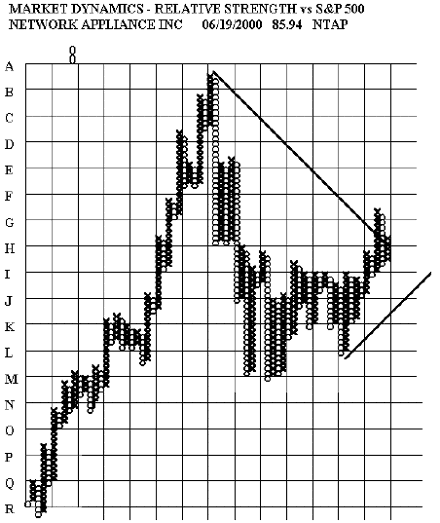
If the Xs and Os on a relative strength point and figure chart were placed by the flipping of a coin – Xs for heads and Os for tails. Using the theory of runs we would be highly suspicious that the coin used to construct the chart was extremely irregular. My tests on many charts indicated far too few runs - which means the coin was crooked. The flips were random but the outcome suggested an underlying process at work and the existence of persistent trends. It is the longterm trends, after all, that we are interested in.

Complex Adaptive System
No functional relationships that last

“ It is statistics not physics” – from Louis Navellier Markets must have uncertainty – No need for a market if there is no uncertainty - because then everyone would agree on price and value. Like evolution in nature - we can understand, describe but can’t predict - Need
to adapt to change as much as predict - Feedback goes both ways – fundamentals to price and price to fundamentals.

For those interested in the implications of Complex Adaptive Systems in the stock market you should visit the Santa Fe Institute’s web site at

http://www.santafe.edu/

Also see Complexity by Waldrop
Also see Dr Brian Arthur’s articles on stock markets.


PerformanceTrading.it ed il suo contenuto sono di esclusiva proprietà degli autori. E' vietata la riproduzione anche parziale di qualsiasi parte del sito senza autorizzazione, compresa la grafica e il layout. Prima della consultazione del sito leggere il disclaimer nella sezione [info].