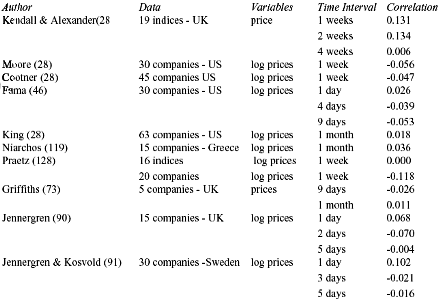
Summary of Findings
Serial correlations in most markets is small. While there may be statistical significance associated with these correlations, it is unlikely that there is enough correlation to generate excess returns.
The serial correlation in short period returns is also affected by price measurement issues and the market micro-structure characteristics.
Non-trading in some of the components of the index can create a carry-over effect from the prior time period, this can result in positive serial correlation in the index returns.
The bid-ask spread creates a bias in the opposite direction, if transactions prices are used to compute returns, since prices have a equal chance of ending up at the bid or the ask price. The bounce that this induces in prices will result in negative serial correlations in returns. Bid-Ask Spread = -√2 (Serial Covariance in returns) where the serial covariance in returns measures the covariance between return changes in consecutive time periods.
Filter Rules
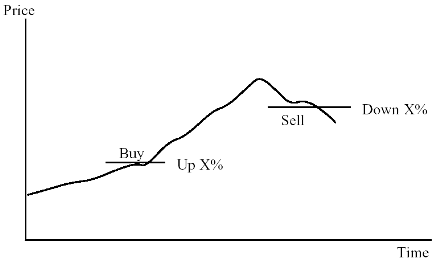
In a filter rule, an investor buys an investment if the price rises X% from a previous low and holds the investment until the price drops X% from a previous high. The magnitude of the change (X%) that triggers the trades can vary from filter rule to filter rule. with smaller changes resulting in more transactions per period and higher transactions costs.
Illustration of Filter Rule
Assumptions underlying strategy
This strategy is based upon the assumption that price changes are serially correlated and that there is price momentum, i.e., stocks which have gone up strongly in the past are more likely to keep going up than go down.
The following table summarizes results from a study on returns, before and after transactions costs, on a trading strategy based upon filter rules ranging from 0.5% to 20%. ( A 0.5% rule implies that a stock is bought when it rises 0.5% from a previous low and sold when it falls 0.5% from a prior high.)
Prof. Aswath Damodaran
Next: Returns on Filter Rule Strategies
Summary: Index